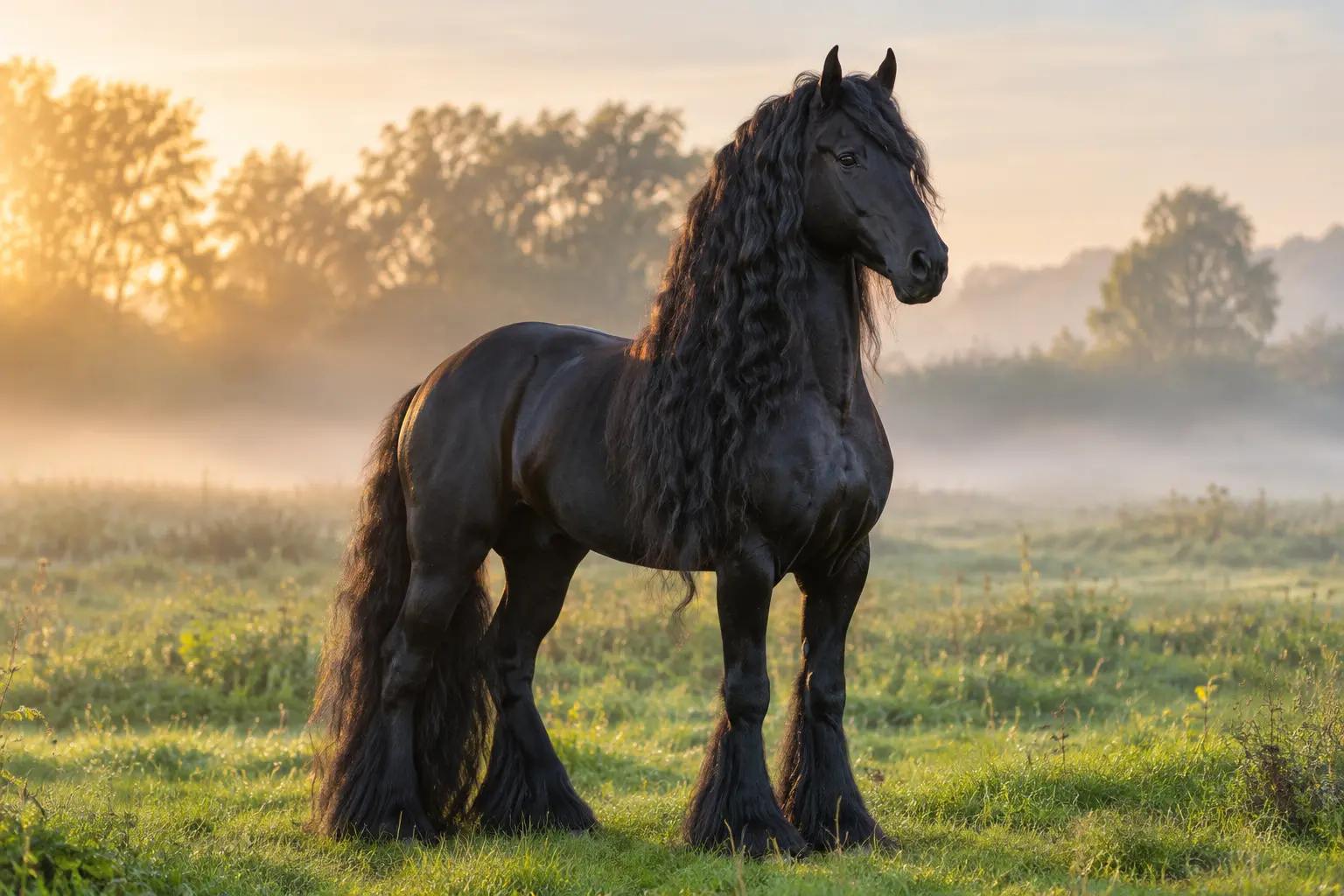
A Friesian horse is a black Dutch breed from the province of Friesland, known for its long wavy mane, feathered lower legs and high-stepping trot. Friesians are used for dressage, carriage driving and pleasure riding, and they are among the most recognizable horses in the world.
They are also a breed with real health concerns, and the price of a good one surprises most buyers. This guide covers where Friesians come from, how they look, which colors are possible, common health problems, daily care and what they cost.
Friesian Horse Quick Facts
| Feature | Details |
|---|---|
| Origin | Friesland, Netherlands |
| Registries | KFPS (Netherlands), FHANA (North America) |
| Height | Usually 15.2 to 16 hands, some reach 17 hands (sources vary) |
| Weight | 1,200 to 1,400 lb (544 to 635 kg) |
| Color | Black. Only a small white star on the forehead is allowed in the registry |
| Temperament | Friendly, intelligent, willing to work |
| Common uses | Dressage, carriage driving, harness shows, pleasure riding |
| Breed type | Often called a warmblood or sport horse. Some sources call it a light draft horse |
| Lifespan | Many sources say 16 to 30 years, and some say the average is shorter than in most breeds |
| Price | Roughly $5,000 to nearly $50,000 in most guides. One guide lists up to $72,500 |
| Population | Estimates range from about 25,000 to over 70,000 worldwide |
Important Facts About Friesian Horses
- The registered Friesian is black. A small white star is the only white marking the studbook accepts.
- The breed came very close to extinction in the early 1900s and has since recovered.
- Dwarfism, hydrocephalus, aortic rupture, megaesophagus, sweet itch and weight gain are the main health concerns to know about.
- Friesians gain weight easily, and their long feathering needs regular cleaning and drying.
- A purebred Friesian is expensive to buy, and a pre-purchase vet exam and DNA test results matter more than the color or the looks.
What Is a Friesian Horse?
The Friesian is a horse breed from Friesland, a province in the northern Netherlands. It is known for a solid black coat, a thick wavy mane and tail, feathering on the lower legs and an arched neck. Today it is ridden and driven in harness.
You may also see the name spelled Frisian. Friesian is the spelling used by the breed registries.
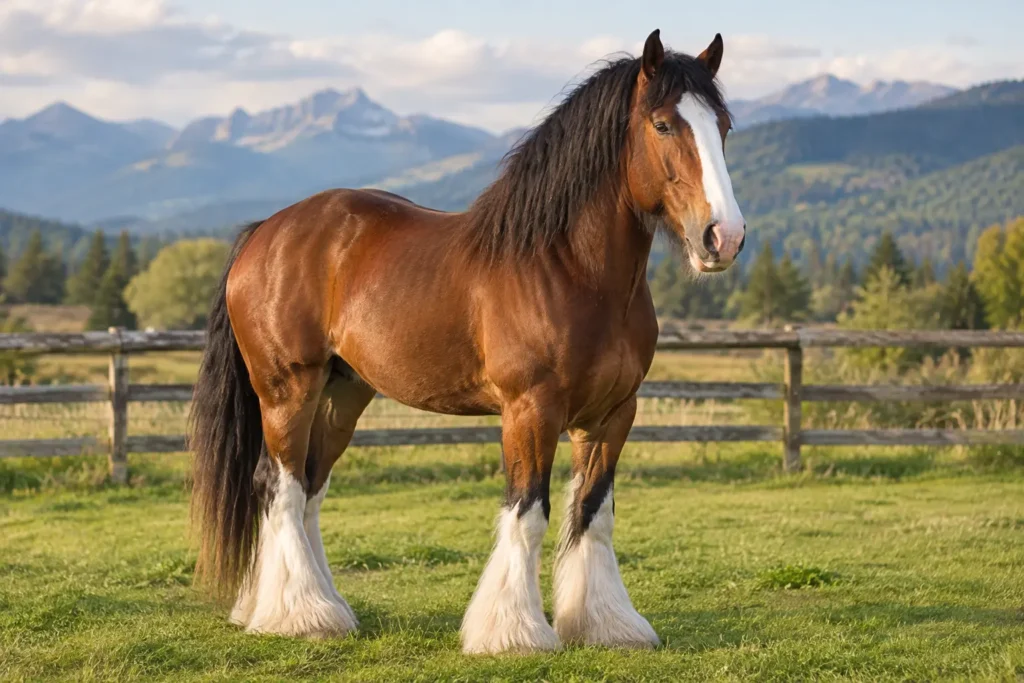
Sources do not agree on how to classify it. Some call the Friesian a warmblood and sport horse, and others call it a light draft horse. Both labels exist because the breed has the heavy bone and strength of a working horse but moves with the lifted, elegant action of a riding horse.
Friesian Horse History
Origins in Friesland
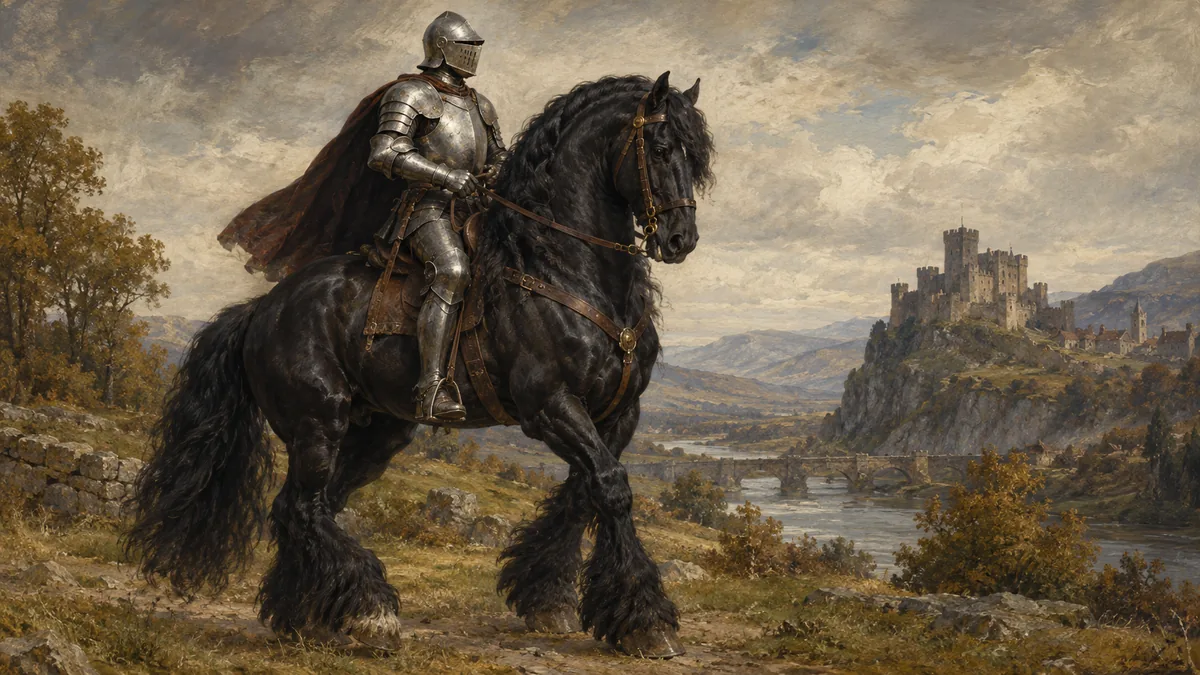
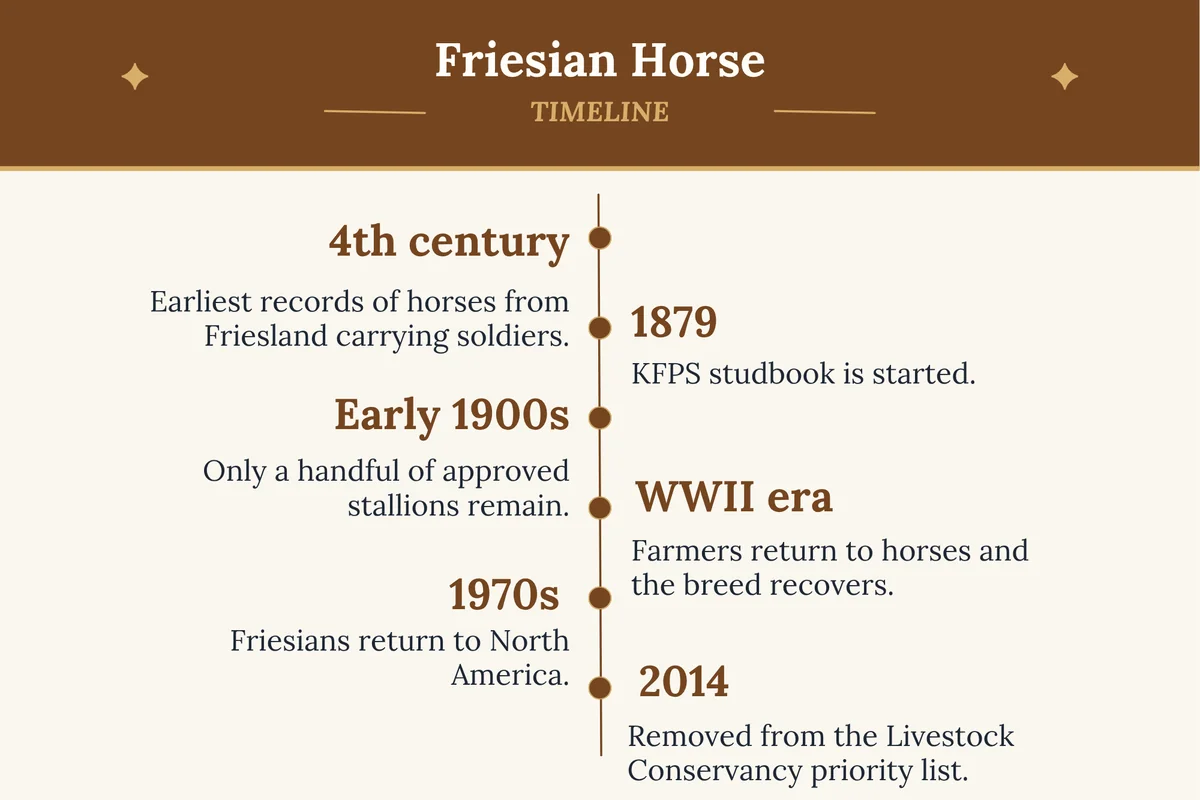
Horses from Friesland have a very long record. One breed guide cites historical sources placing soldiers from Friesland on local horses as early as the 4th century, and drawings of horses that look like Friesians date to the 11th century. In the Middle Ages these horses were strong enough to carry knights in armor.
Outside blood arrived over time. Arabian horses came through returning crusaders, and during the 16th and 17th centuries, when the Netherlands was under Spanish rule, Andalusian horses influenced the breed. A genetic study found that the modern Friesian is a distinct breed that does not descend from English Thoroughbred blood, unlike many other European riding horses.
The official studbook was started in 1879, and it is managed today by the KFPS, the Royal Association of the Friesian Horse Studbook.
Near extinction
In the 18th and 19th centuries Friesians were popular as trotting and carriage horses. By the late 1800s they had fallen out of fashion, and many were crossed with faster trotting breeds. Sources give different numbers for how bad it got. One says only 15 approved stallions remained in 1902, and others say just three purebred stallions were left by 1913.
The Livestock Conservancy reports that by the middle of the 1900s the population was only about 500 horses. Fuel shortages during World War II pushed Dutch farmers back to horses for transport and fieldwork, and a riding association called De Oorsprong toured the country to remind people of the breed. Interest returned, and numbers have grown since.
Friesians in North America
Dutch settlers brought Friesians to North America in the 1600s, but no pure population was kept, and the breed disappeared from the continent through crossbreeding. Driving enthusiasts brought it back in the 1970s. The Friesian Horse Association of North America (FHANA) is the exclusive North American affiliate of the KFPS, and only horses that meet Dutch standards can be registered with it.
The Livestock Conservancy removed the Friesian from its conservation priority list in 2014. Its popularity also grew through film, and a Dutch news report credits the stallion Frederik the Great, imported in 2006 and praised on American television, for a jump in demand.
Characteristics of Friesian Horse
Size & weight
Most Friesians stand between 15.2 and 16 hands, although the range in the sources runs from about 15 to 17 hands. The studbook sets minimums. Mares and geldings must be at least 15 hands, and stallions must reach 15.3 hands by age four. Adults usually weigh 1,200 to 1,400 pounds.
Build & appearance
The ideal Friesian has an expressive head with small ears, large eyes and wide nostrils. The neck is high-set, arched and strong. The withers are well defined, the back is muscular, and the croup slopes. The legs are straight with wide hooves, and the whole horse has a rectangular frame.
Two features set the breed apart from other black horses. The first is the long, thick, often wavy mane, forelock and tail. The second is feathering, the long hair that grows from the lower legs over the hooves.
Movement
Friesians move with a lifted, rounded action. The trot is the showpiece, with high knee action and good flexion in the joints, and the power comes from the hindquarters. This movement comes from their carriage horse ancestry, and it is why the breed does well in driving classes.
Friesian Horse Colors
The black Friesian horse is the standard in the registry, and a small white star on the forehead is the only white marking allowed. Black bay and dark brown shades that look black are accepted in some descriptions. Any other white marking on the body or legs can keep a horse out of the main studbook.
This was not always the case. Early records show greys and bays in the breed, and old registry entries use a color called blue, which may have included blue silver dapple, roan or gray.
Can a Friesian horse be white?
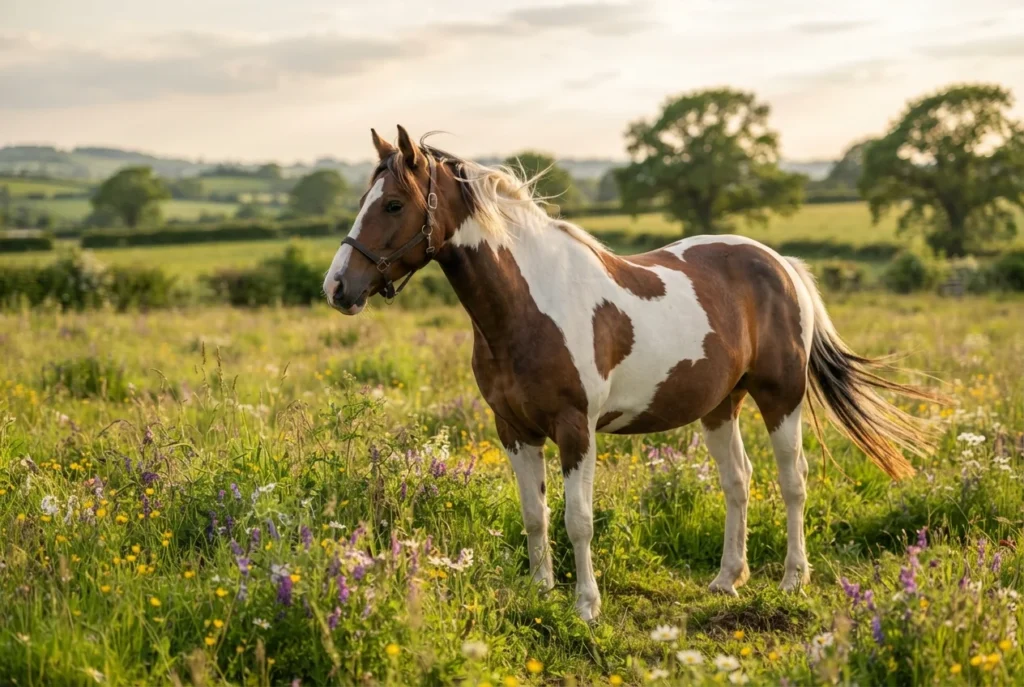
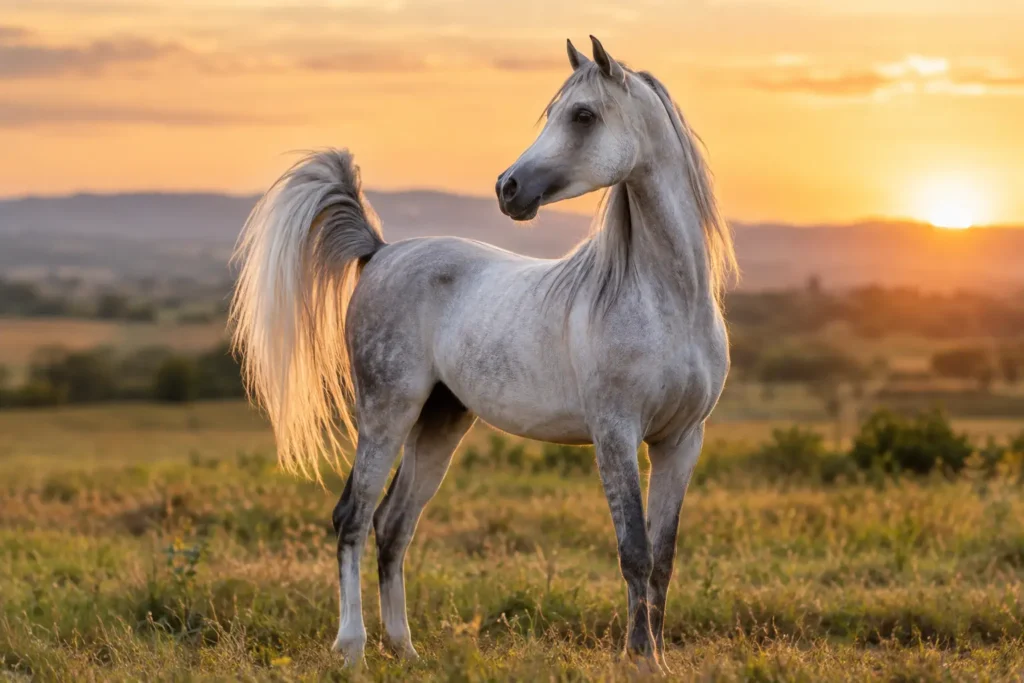
A registered purebred Friesian cannot be white. Horses sold or posted online as white Friesians are usually crossbreds, gray horses of another breed, or edited pictures. One US breed guide says the famous horse often called the first white Friesian is a Friesian and Arabian cross. Some crossbred registries do accept Friesian crosses with pinto markings if the horse has a minimum amount of documented Friesian blood.
Can a Friesian horse be chestnut?
Chestnut can appear, but it is not accepted for the main studbook. A horse is chestnut when it carries two copies of the recessive red gene. Two black horses that each carry one copy of that gene have a 25 percent chance of producing a chestnut foal each time. The Dutch registry has worked to reduce the gene by genetic testing of stallions, and chestnut foals cannot be registered with the KFPS or FHANA. Sport horse and crossbred registries accept them.
| Color | Accepted in KFPS/FHANA studbook? | Where you may see it |
|---|---|---|
| Black | Yes | Registered purebreds |
| Black with a small white star | Yes | Registered purebreds |
| Chestnut | No | Unregistered purebreds, crossbred registries |
| White or gray | No | Crossbreds or other breeds |
Friesian Horse Temperament & Training
Friesians are described as friendly, intelligent and willing. They tend to bond with people and learn quickly. The Livestock Conservancy rates the temperament as bold and the experience level as intermediate, while PetMD says a well-trained Friesian can suit riders of many levels, including young riders who are comfortable with such a large horse.
Both views are useful. A calm, trained Friesian can be a good horse for a newer rider, but an untrained one is big and strong, and a beginner needs a trainer nearby.
Training should be positive and paced. A study on young Friesian stallions suggests the breed may tire faster than some others, so build fitness gradually and watch for poor performance, which can also be a sign of a heart problem.
What Are Friesian Horses Used For?
Dressage is the most popular riding sport for Friesians. They are not usually competitive at the top levels against modern warmbloods, but many riders enjoy them at every level. The breed also excels in carriage driving and harness shows, and it is used for pleasure riding and trail riding.
PetMD notes that their build makes them less suited to jumping and endurance. The US Equestrian rulebook has a chapter for Friesian and Part Bred Friesian classes, including in-hand, park horse and English pleasure. Friesians have also appeared in films such as The Mask of Zorro, Sense and Sensibility and Ladyhawke.
What is a Friesian sport horse?
A Friesian sport horse is a crossbred horse with Friesian blood that is bred for sport. One reference says the minimum is 25 percent Friesian, but the exact rule depends on the registry.
Friesian Crosses
Friesians are crossed with many breeds, including Appaloosa, Percheron and Paint horses, mostly to create a sport or riding horse with Friesian looks and a wider range of colors. FHANA strongly discourages breeding registered Friesians to other breeds, so crosses are registered separately.
A cross can mix traits in unpredictable ways. Look at the individual horse and both parents, and ask:
- What percentage is Friesian, and can it be documented?
- Which registry is it in?
- What are the health and temperament records of both parents?
Friesian Horse Health Problems
The modern Friesian comes from a small founding population, and inbreeding has left the breed with several inherited problems. Many of them are linked to a tendency toward connective tissue abnormalities. This section is for awareness, and any symptom needs a vet.
Dwarfism & hydrocephalus
Dwarfism is an inherited recessive condition. Affected horses have normal heads and backs but shorter limbs and ribs, along with loose tendons and joint problems. A DNA test can find carriers, and breeders can avoid mating two carriers.
Hydrocephalus is another recessive condition, where fluid builds up in the brain and the head becomes enlarged. One study found it in about 2.5 of every 1,000 Friesian foals. Most affected foals are stillborn or born with severe problems, and a DNA test is available.
Aortic rupture & megaesophagus
Aortic rupture is a sudden tear in the main artery from the heart, and it can cause sudden death. Some horses show signs first, such as repeated colic, a higher resting heart rate, swelling or a raised temperature. Call a vet if your horse shows these or any unusual heart rate.
Megaesophagus is a stretched esophagus that moves food poorly. It can cause choke, weight loss, drooling and aspiration pneumonia. Vets can manage some cases with softened feed, but it is best avoided through careful breeding.
Skin problems
The long feathering holds moisture and dirt, so Friesians are prone to pastern dermatitis, also called mud fever. One study found that about 18 percent of Friesians had insect bite hypersensitivity, commonly called sweet itch.
Problems for mares
Retained placenta after foaling is much more common in Friesian mares. One study reported it in up to 54 percent of births, compared with under 10 percent in horses in general.
Weight & metabolic risk
Friesians are easy keepers and gain weight quickly. Obesity can lead to joint strain, equine metabolic syndrome and laminitis. A cresty fat deposit on top of the neck should not be mistaken for the breed’s natural arch.
The breed’s current concerns
Dutch breeders have warned that inbreeding is increasing. A 2022 study found that one third of Friesian foals were direct descendants of the ten most popular stallions. In July 2026 the KFPS was reported to be working on new selective breeding guidelines. Check the KFPS website for the current status.
How Long Do Friesian Horses Live?
Many sources list a Friesian lifespan of 16 to 30 years, but PetMD says the average is shorter than in other breeds, with some horses living only around 16 years. Individual horses vary a lot. Genetics, weight, heart health and good vet care all play a role.
Friesian Horse Care
Feeding
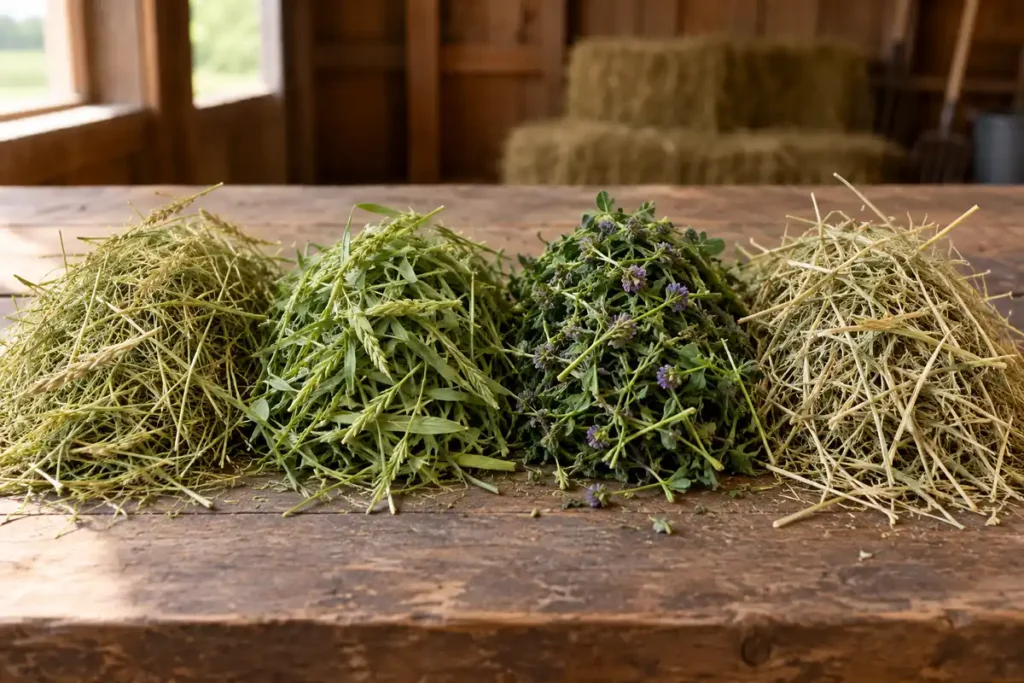
A Friesian should have forage as the base of the diet. Most adult horses eat about 2 percent of their body weight in forage per day, which is about 26 pounds for a 1,300 pound horse. Grass hay that is not too mature and is low in sugar and starch suits an easy keeper. Always provide clean water and salt, and ask a vet or equine nutritionist to check the diet. A balanced mineral supplement is often needed because hay alone lacks some nutrients.
Horses in heavy work may need more energy, and Friesians that gain weight easily may need less hay and a slow feeder. See the Horse Diet section of this site for the basics of feeding.
Weight management
Keep your horse at a body condition score of about 5 on the 9-point Henneke scale. Check the neck, ribs and tail head regularly. Weight gain can be fast if exercise stops, and laminitis is a risk, so adjust the diet quickly when work drops.
Grooming
The mane, tail and feathering need more time than on most horses. Brush daily with a body brush and a mane and tail brush. Keep the feathering clean and dry to prevent mud fever. To keep the mane long, pull the longest hairs instead of cutting it. Trim the tail so it does not drag on the ground, and trim or leave the feathering as you prefer.
Hoof care
Friesians generally have good hooves, but connective tissue weakness makes regular farrier visits important. Pick out the hooves daily and ask your farrier about balance and shoeing for your horse’s work. See the Hoof Care section for more.
Exercise & turnout
Free movement helps bones and connective tissue and lowers stress. Keep stall time low and give as much turnout as you safely can. Bring fitness up slowly and ask your vet to check the heart if performance drops or the heart rate seems off.
How Much Does a Friesian Horse Cost?
A purebred Friesian usually costs from about $5,000 to nearly $50,000, according to most guides. One breed guide puts a FHANA-registered horse at $20,000 to $50,000, and another lists a range of $9,500 to $72,500. A Dutch news report says top purebreds can reach close to $50,000 and a single vial of semen from a top stallion can cost as much as 1,500 euros.
The price depends on:
- Age and training level
- Bloodline and studbook premiums
- Registration status and papers
- Whether it is a mare, gelding or approved stallion
- Location and breeder reputation
Friesian crosses and unregistered horses usually cost less, but they come with different risks.
The purchase price is only the start. Plan for feed, hay, farrier visits, vet care, vaccines, dental work, boarding or land, tack and insurance. Costs depend on where you live, so get local quotes before you buy.
Before you buy
- Ask for KFPS or FHANA registration papers and check them.
- Ask for DNA test results for dwarfism and hydrocephalus.
- Book a pre-purchase vet exam and ask the vet what to include, including heart and metabolic checks.
- Meet the parents if you can.
- Ask about the breeder’s health and temperament record.
Friesian vs Similar Breeds
| Feature | Friesian | Andalusian | Percheron |
|---|---|---|---|
| Origin | Netherlands | Spain | France |
| Build | Strong, compact, rectangular | Lighter, athletic | Heavier draft type |
| Usual color | Black | Often gray | Often gray or black |
| Known for | Dressage, driving, looks | Classical dressage | Draft work, driving |
| Influence | Andalusian blood shaped the Friesian | Parent breed in Friesian history | Sometimes crossed with Friesians |
Is the Friesian Breed Rare?
The Friesian is no longer endangered, but it is still a small breed. Estimates of the world population range from about 25,000 to over 70,000, depending on the source and year. The Livestock Conservancy listed the breed as recovered in 2014.
Is a Friesian Right for You?
A Friesian suits you if you want a willing, eye-catching horse for dressage, driving or pleasure riding, and you can afford the purchase, the grooming time and the vet bills. It may not suit you if you want a low-maintenance horse, a jumper or an endurance horse, or if you are a first-time owner without a trainer.
Frequently Asked Questions
Are Friesian horses always black?
Registered Friesians are black. Chestnut can occur through genetics, but chestnut foals cannot be registered with the KFPS or FHANA.
Are there white Friesian horses?
No registered purebred Friesian is white. White or gray horses described as Friesians are usually crossbreds or another breed.
How big do Friesian horses get?
Most stand 15.2 to 16 hands and weigh 1,200 to 1,400 pounds. Some reach 17 hands.
What is the average Friesian lifespan?
Many sources say 16 to 30 years, but the average may be shorter than in other breeds.
Are Friesian horses good for beginners?
A well-trained, calm Friesian can work for a newer rider with a trainer. Their size and strength make an untrained Friesian a poor choice for a beginner.
Is a Friesian a warmblood?
Many sources classify it as a warmblood and sport horse. Some call it a light draft horse.
What does a purebred Friesian cost?
Most guides give $5,000 to nearly $50,000 for a purebred, with some horses costing more.
Where does the name come from?
The breed is named after Friesland, the Dutch province where it began.